

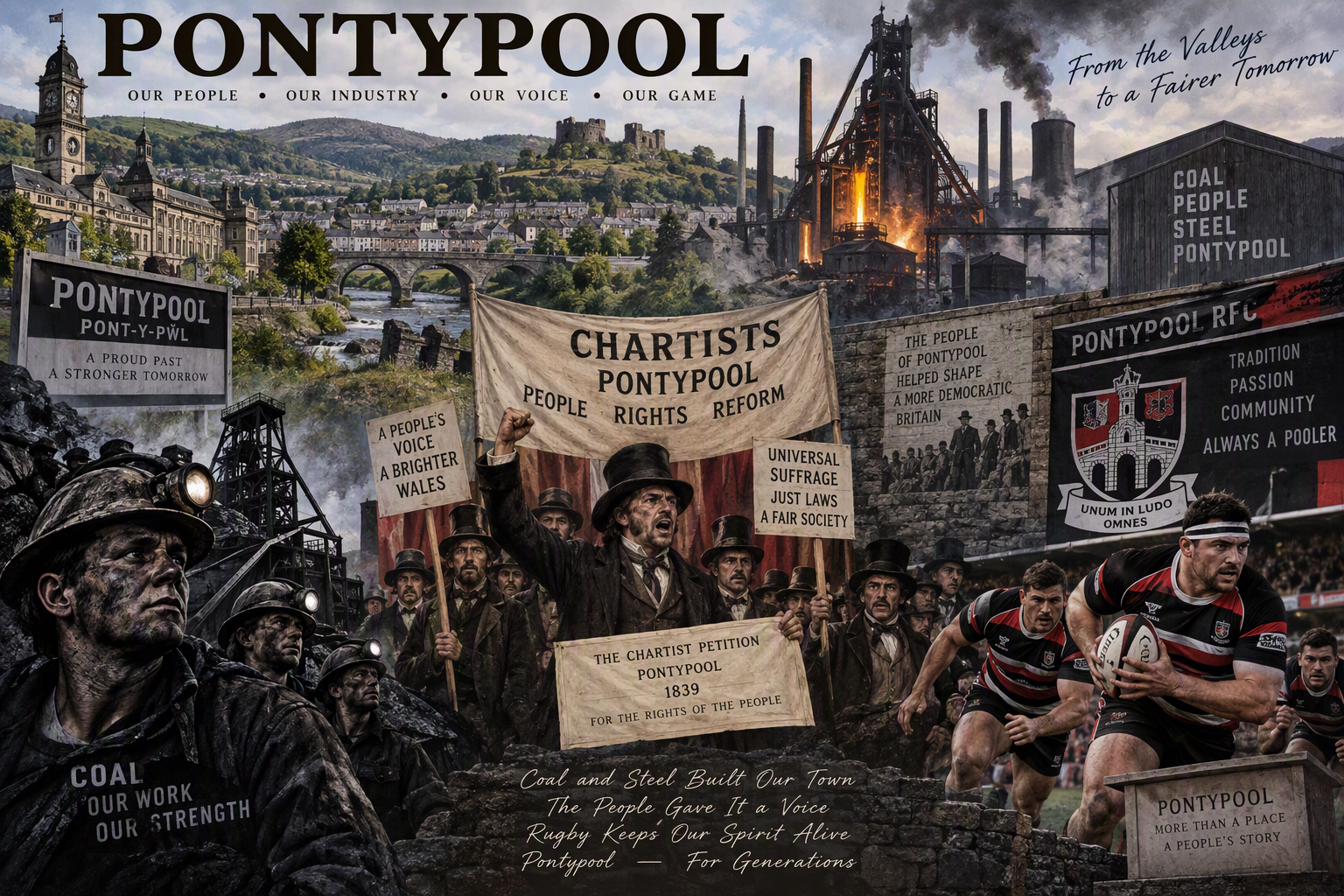
Pontypool’s regeneration should not be about replacing its past, but building on it. The town has a rich industrial heritage that helped shape not only the valleys but the wider world, from its ironworks and engineering achievements to its proud sporting traditions. Too often, regeneration schemes focus solely on new buildings and retail developments, overlooking the unique identity that makes a place special.
By weaving Pontypool’s history into future developments, the town can create a stronger sense of place and pride. Historic landmarks should be restored and celebrated, public spaces could tell the story of the town’s industrial pioneers, and heritage trails could connect visitors with the people and industries that put Pontypool on the map. New investment should complement the character of the town rather than erase it.
Successful regeneration respects the past while embracing the future. If Pontypool can combine modern ambitions with a visible celebration of its heritage, it will create a town centre that is not only more attractive and vibrant but also unmistakably Pontypool.
POTYPOOL WAS FAMOUS FOR MANY THINGS

PONTYPOOL JAPANWARE
During the 1660s, Thomas Allgood of Northamptonshire was appointed manager of the Pontypool Ironworks. Allgood developed the Pontypool 'japanning' process, whereby metal plate could be treated in a way that generated a lacquered and decorative finish. Thomas Allgood died in 1716, having been unable to commence production of his Pontypool Japanware but the increased creation of tinplate at Pontypool from the early eighteenth century allowed for japanning to enter large-scale manufacture.[9] There was a growing demand for these artistic, luxury products and Allgood's sons, Edward and Thomas, established a Japan works in Pontypool,

BRITISH NYLON SPINNERS/ICI
When completed, the Pontypool site had a production plant, a pilot plant, a building devoted to testing and developing the products to support their successful use by customers (Technical Development Department), an administration block and a research and development block.[14] Most of the buildings were still present in 2011. They can be found at the junction, near Little Mill, between the A4042 and the minor road to Mamihlad.
At its height it employed over 6 thousand covering 4 shifts. A sad loss to Pontypool and the valley's when it closed.

TINPLATE WORKERS
Known has the Town Forge, it produced high grade tinplate, nestled between the Afon Llwyd and Osborne Rd the mills were fed by a large pond. Inside the grounds was a row of two up and down cottages with toilets going into the river. The Pontypool Works at Town Forge finally ceased production in the late 1950s.
The author of this site was born in 1945 in the first cottage and his future wife next door...both delivered by his Grandmother as it was in those days.

PONTYPOOL RUGBY CLUB

COAL INDUSTRY

PONTYPOOL LIBRARY

PANTEG STEELWORKS

PONTYPOOL RAILWAY STATION

TOWN HALL TOILET

PONTYPOOL CHARTISTS
William Jones (1809–1873) was a political Radical and Chartist, who was a former actor, working as a watchmaker at Pontypool in Monmouthshire and also kept a beer house called the Full Moon on George Street.
He was prosecuted for his part in the Chartist Newport Rising at Newport, Monmouthshire on 4 November 1839.
Along with John Frost and Zephaniah Williams, he was appointed a leader of a column of men in what is sometimes regarded as the greatest armed rebellion in 19th-century Britain.

Emma Thompson
